


Use of Concrete Canvas in Ditches:
A Novel and Efficient Method for Protection on Hydraulic Slope and Bed
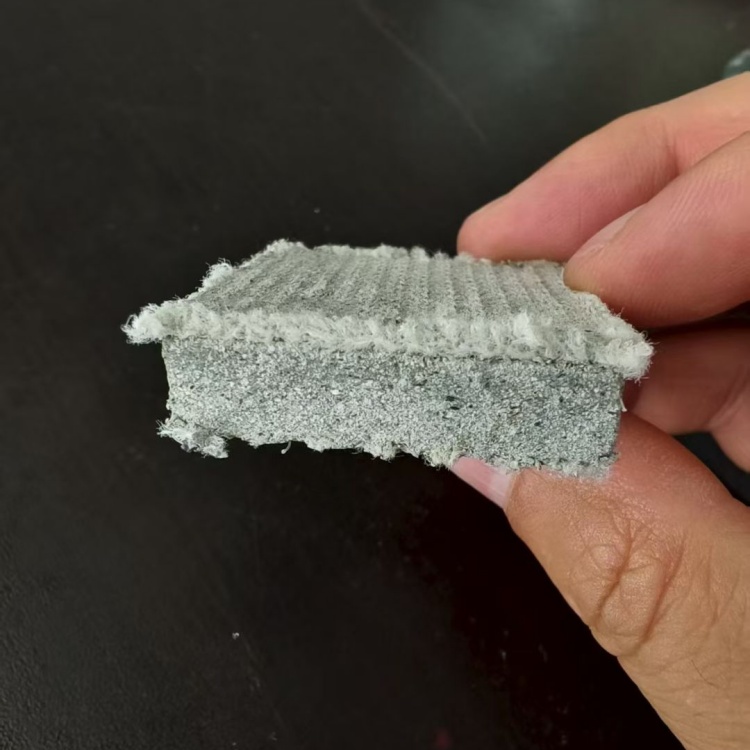
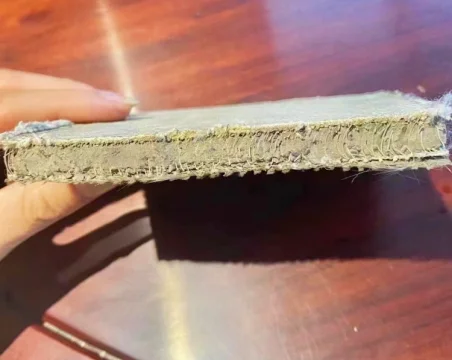
Abstract: Concrete Canvas is a revolutionary new material technology that uses a flexible fibrous substrate impregnated with cementitious slurry to form a thin, durable, water and fire resistant concrete layer. In seepage control, slope preservation, and reinforce of ditch engineering, it is gradually replacing cast in-situ concrete, stone pitching or precast slabs for its characteristic of rapid construction speed, environmental friendly and high strength. It is increasingly being used in the water conservancy, agriculture and infrastructure construction.
Cement blanket advantages(Why it is applied in ditches?)
Concrete Canvas’ Key Benefits (Why Use It for Ditches?)
Extremely Convenient and Efficient Construction:
· Without large machinery: Easy to carry and lay by hands as the material is on roll.
·Formwork Free And Curing Free: just add water after laying and it will come into shape without any other wet work process. It foregoes the traditional 28 day curing period, accelerating construction over 10 times faster than that of conventional means.
· Suitable for Complex Terrain: The flexibility of the strip itself, can follow closely to the ditch bed without gaps between the belts and dam, since it can be parallel even with water surface.
. Excellent Engineering Performance:
Rapid Curing & High Strength: It reaches the strength level of standard concrete (C20~C25) within 24 hours after hydration, making it a fast set solution against underwater flow erosion.
· Continuous and Impenetrable: It forms a single, seamless “thin-shell” of reinforced concrete that directly inhibits any form soil erosion or water percolation.
· Erosion Resistant & Durability: Dense surface resists puncture by water flow, rain and freeze thaw cycles for a long service life.
Good Ecological and Economic Benefits:
· Possibility of ecological slope protection: A superficial ground planting can be added to soil for grass seedlings, and the two are used in combination with engineering protection as well as an ecological landscape.
· Low Overall Cost: Saving a lot of labor, equipment, template and time, short duration; overall does not increase costs.
· Low Material Transportation Loss: Rolled material reduces the volume of waste material on-site.
Primary Application Scenarios in Ditches
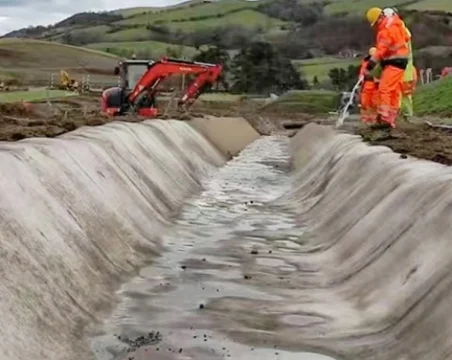
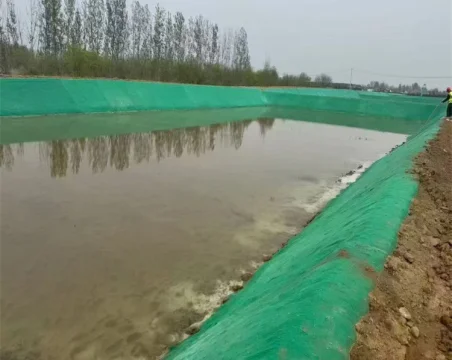
Lining Of∕ Above Irrigation & Drain Outlets: Replaces concrete U-Channels to minimize conveyance losses and increase water utilization efficiency.
Slope Drain Ditch Reinforcement:For long or short drainage ditches on the highway,railway and slope to prevent scour and damage.
River Regulation and Protection of River-Beds: Before moderate floods, the bed and banks of small rivers are stabilized to avoid soil erosion.
Interceptor/Flood Control Ditches: To intercept and water which rushes down mountainsides, or other sloped land in great volume and velocity into valleys a system of protection ditches can he constructed to take the initial shock effect instead of letting it run directly on to the valley floor.
Quick Ditch Emergency Repairs: Offers fast, matching “band-aid” repairs for deteriorated concrete ditches.
Common Sequence Builder (Taking a Trapezoidal Ditch as an Example)
Base Preparation:
· Remove roots, debris and loose material from the ditch bed and slopes. Prepare a smooth, level surface free of moisture.
· Limy blocks to bulk up loose; med. compact areas were used!
Material Laying:
· Lay upstream-joint to downstream-joint as not toward the liquid flow.
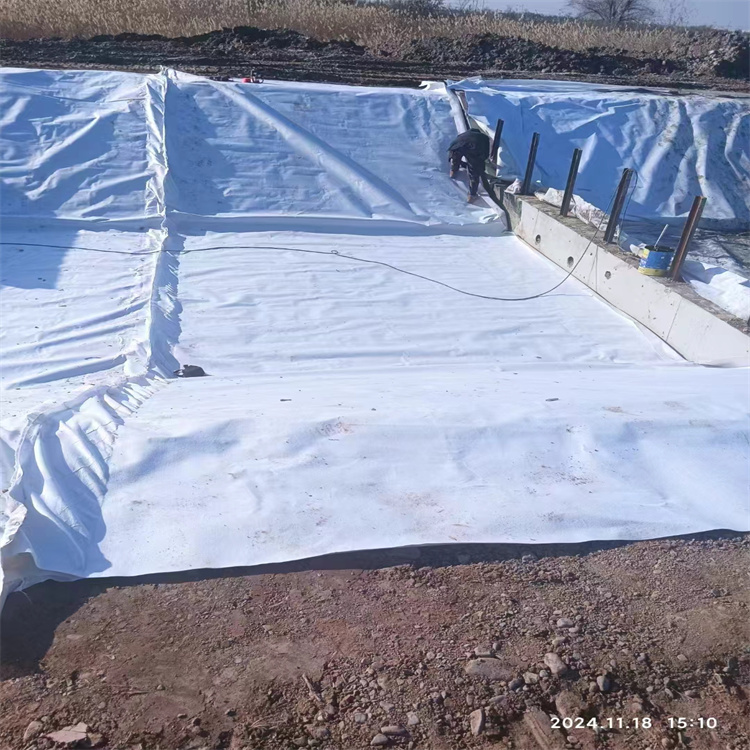
· Begin by rolling out the Concrete Canvas in the direction of the ditch, ensuring good contact with bed and slopes. To prevent them from being blown over or otherwise disturbed, while laying the top of mast contains at least two mechanism plates either U-pins or stakes.
· The ideal longitudinal overlap width of adjoining rolls is 10-15 cm. Ensure tight overlap.
Joint Treatment and Activation:
Step 5–Critical Step: where the sheets overlap, lift one of the edges of the top page. Pre- wet bottom sheet by spraying with water. Next, place the upper sheet in position and apply a cement slurry or special overlapping adhesive to the joint for achieving monolithic sealing.
· Full Hydration Activation: Use a sprinkler or hose pipe to uniformly drench the Concrete Canvas (around 2-3 runs over would be typically fully soaked). The material will start to set as hydration progresses.
Finishing and Curing:
· Surfacce finishing or texture can be applied within 1-2 hours of hydration.
· Ready to use, no need to water or cover. It is walkable in 24 hours and stronger at around 7 days.
Key Considerations
Base Requirement: The base needs to be stable. On soft ground and in high fill areas, special foundation technologies are needed to prevent damage caused by differential settlement.
Drainage: In groundwater pressure ditches, design weep holes or use geotextile drainage to relieve uplift pressure if there is one behind the sheet.
High Scour Areas: In scenarios where the ditch velocity is very high then a thicker grade of Concrete Canvas should be used, or supplementary components such as scour checks or stilling basins can be included on top.
5Q3 Construction Environment The following construction conditions should be avoided during construction, so as to avoid adverse effect to the hydration reaction and quality when construct in too low temperature(below 5℃), windy weather and under direct strong sunlight.
Professional Installation: It is advice(cast by ‘s valuable customer) only to be installed by a professional to ensure quality of the installation, it need key steps like overlap and hydrate.
Comparison with Traditional Solutions
| Characteristics | Cement blanket | traditional cast-in-place concrete | masonry/precast panels |
| Construction speed | Extremely fast (measured in hours/days) | Slow (long period for formwork setup, pouring, and curing) | Moderate |
| Terrain adaptability | Excellent (flexible fitting) | Poor (template constraints) | Average (many seams) |
| Overall quality | Good (seamless thin shell) | Good | Poor (dependent on seams) |
| Eco-friendliness | Good (can be landscaped); | Poor | Average |
| Dependence on human labor: | Low | High | High |
| Overall cost | Low (savings on indirect costs) | High | Medium |
Conclusion
The cement blanket is one of the lightweight,rapid and human-friendly innovation for ditch engineering! Its especially applicable to projects with critical timelines, challenging terrain and limited large machinery access or where environmental benefits are a priority. The cement blanket can be used to treat problems of erosion and leakage in ditches, restoring the resilience of water infrastructures based upon thin-cement technology. An engineering and technical material that should be more widely promoted.
Related News