


With the continuous advancement of environmental remediation efforts, the substantial generation of sludge has become an unavoidable reality. As the most valuable potential resource, sludge holds significant
development potential, particularly in solidification technologies. Geotextile bags have been widely adopted for sludge dewatering, offering advantages such as rapid processing, simplicity, and low investment and
operational costs. These geotextile bags have been successfully implemented in various engineering applications, including river and lake dredging sludge dewatering, foundation reinforcement, land reclamation, dam construction, and sludge landfilling.
Currently, three primary methods are commonly used for resource recovery from waste sludge: physical dewatering, thermal treatment, and chemical solidification. The most direct physical dewatering approach involves mechanical processes using equipment like centrifuges and filter presses to reduce sludge moisture content. However, this method requires specialized facilities and equipment, incurs high processing costs, and yields low efficiency, often necessitating secondary treatment before sludge can be utilized in engineering projects. Thermal treatment primarily employs methods such as drying and sintering to initiate chemical reactions under high temperatures, altering soil structure and
transforming sludge into high-quality geotechnical materials. This method imposes strict site requirements, limiting its application scope. Chemical treatment involves adding solidifiers as soil modifiers to the sludge.
Through interaction between the soil and solidifiers, the sludge’s properties are modified to meet engineering requirements. This method effectively converts high-moisture, low-strength waste sludge into high strength, low-permeability engineering soil, featuring large processing capacity, short construction periods, and cost-effectiveness, achieving project requirements in a single treatment cycle. In summary, chemicalsolidification of dredged sludge into high-quality geotechnical fillers benefits river dredging and urban environmental purification. It also enables resource recovery and development of dredged sludge, turning hazards into advantages and promoting sustainable social development.
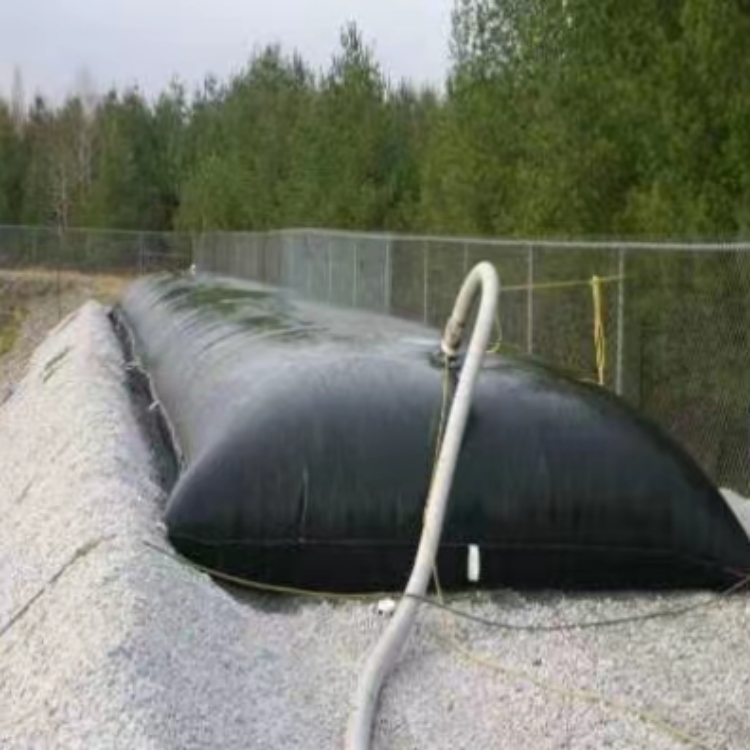
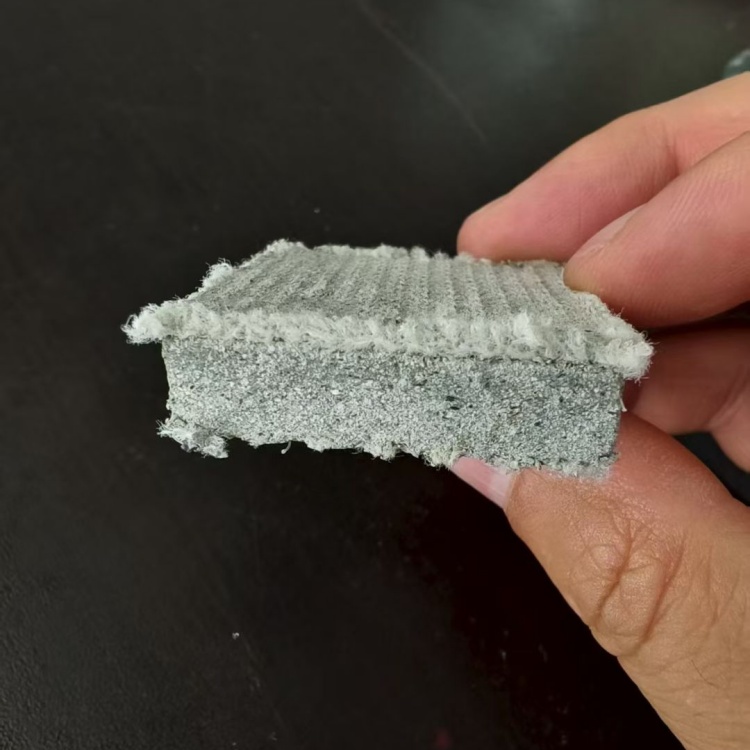
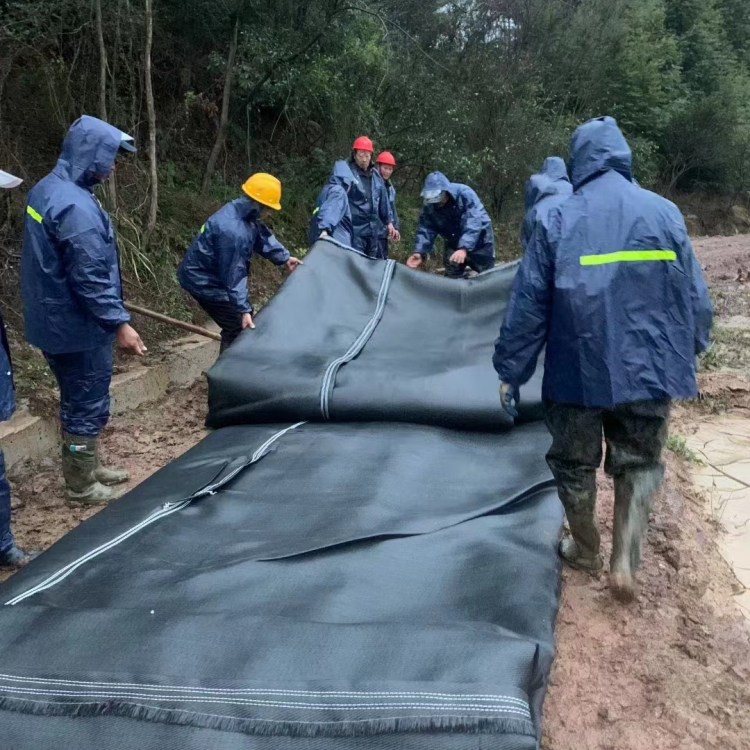
Ⅰ. Geotextile bag is a type of filter structure woven from polypropylene yarns.Tubular geotextile bags have excellent properties of solid-liquid separation. Their diameter can be changed according to the need (1-20 m) and their length can reach up to 200 m. They have high strength, filtration performance and long-term UV resistance.
1、 Dewatering Technology of Geotextile Bag
Geotextile Bag Dewatering Principle: This process utilizes two key mechanisms-the filtration structure of the geotextile bag and internal liquid pressure. By adding chemical agents to promote sludge-water separation, water seeps out while solid particles remain trapped,achieving effective dewatering and solidification. The dewatering process consists of three stages: Filling, Dewatering, and Consolidation.
(1)Filling: Sludge is pumped into the geotextile bag through pipelines. To accelerate dewatering, flocculants may be added to enhance particle consolidation. (2) Dewatering: Clean water is discharged through the bag. The filtration structure and internal pressure work together, with dewatering agents boosting efficiency. After dewatering, over 99% of
solid particles remain in the bag. The leachate can be collected and recycled within the system. (3) Consolidation: Once the bag is fully filled, the geotextile bag and its contents can be disposed of at landfills or the consolidated material repurposed when appropriate.Bag Selection
2、 The geotextile bag is made of high-toughness polypropylene, with
the following specifications:
| Project | Metric | ||||||||||||||||||||||
| 60-60 | 80-80 | 90-120 | 100-100 | 120-120 | 175-175 | 200-200 | 240-240 | 300-300 | 350-350 | ||||||||||||||
| Crackstrength (kN/m) | MD | ≥60 | ≥80 | ≥90 | ≥100 | ≥120 | ≥175 | ≥200 | ≥240 | ≥300 | ≥350 | ||||||||||||
| CMD | ≥60 | ≥80 | ≥120 | ≥100 | ≥120 | ≥175 | ≥200 | ≥240 | ≥300 | ≥350 | |||||||||||||
| Elongation atbreak (%) | MD | ≤16 | |||||||||||||||||||||
| CMD | ≤13 | ||||||||||||||||||||||
| Mass deviation rate per unit area (%) | ±5 | ||||||||||||||||||||||
| Static burst strength(kN) | ≥7.8 | ≥10.0 | ≥10.0 | ≥13.0 | ≥15.0 | ≥18.0 | ≥20.0 | ≥23.0 | ≥25.0 | ≥28.0 | |||||||||||||
| Trapezoidal tearingstrengthForce (kN) | ≥0.65 | ≥0.90 | ≥0.90 | ≥1.08 | ≥1.50 | ≥2.00 | ≥2.40 | ≥2.60 | ≥2.90 | ≥3.10 | |||||||||||||
| Equivalent pore size (O90)(mm) | 0.07~0.6 | ||||||||||||||||||||||
| Vertical permeabilitycoefficient (mm/s) | K × (10-1~10-3), where K= 1.0~9.9 | ||||||||||||||||||||||
| Ultraviolet resistance(%)FluoresceinExternal lightingmethod | ≥90 | ||||||||||||||||||||||
| Antacid and alkali resistance (%) | ≥90 | ||||||||||||||||||||||
| Antioxidant perfo-rmance (%) | ≥80 | ||||||||||||||||||||||
| Joint strength (kN/m) | ≥32 | ≥43 | ≥90 | ≥70 | ≥96 | ≥130 | ≥160 | ≥200 | ≥240 | ≥290 | |||||||||||||
3、 Selection of Dehydrating Agents and Titration Tests
According to the different characteristics of the sediment, such as
the composition, organic matter content, soil category, etc., the efficiency
of slurry dewatering and the quality of the effluent will be affected.
Therefore, before the implementation of the project, titration test should
be carried out to select the appropriate reagent and the concentration of
water added.
4、 slurry filling
After the slurry begins to fill, close monitoring of the bag volume changes is required at the construction site to prevent bag rupture. The maximum filling height for geotextile bags is generally 2.5 meters. Given the pumping efficiency, a single vertical and horizontal filling cycle takes approximately 2 hours. At this point, the pipeline should be switched, and construction should resume only after the bags are fully dehydrated. A 1000 m³ geotextile bag filling cycle typically lasts about 5 days. If stacking of geotextile bags is required, the second layer can only be laid and filled after the first layer is fully solidified. To ensure stability during the second layer’s filling, adjacent grooves in the first layer’s bags may be filled with similar aggregate materials.
5、 treated effluent
The dewatering performance of geotextile bags can be optimized by adjusting chemical dosages or through bag-specific modifications, such as multiple coating applications, controlled percussion, and preloading.
To enhance efficiency, excess water should be promptly pumped out of the collection ditch. After multiple filling and dewatering cycles, the geotextile bag reaches its designed capacity, at which point the filling process concludes. The bag then undergoes natural dewatering until solidification, typically reducing moisture content to below 40% within approximately three weeks.
II. Dewatering Process Diagram of Geotextile Bag
1. Sludge Preparation & Conditioning
Waste slurry is pumped into a mixing tank, then flocculant / coagulant is added to improve particle agglomeration.
2. Filling the Geotube
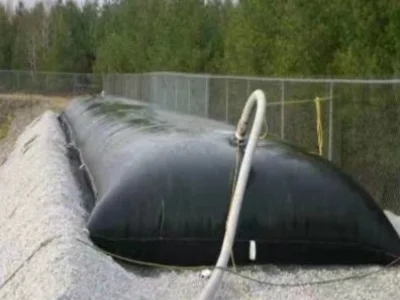
The conditioned slurry is pumped under pressure into the high-strength geotextile tube (Geotube).
3. Filtration & Dewatering
Clean water permeates through the geotextile while solids are retained inside.
Water drains by gravity and compression.
4. Consolidation & Drying
The trapped solids gradually consolidate, reducing moisture content over time.
Multiple fill cycles may be applied.
5. Effluent Collection & Treatment
Filtered water is collected in drainage ditches or ponds for treatment or reuse.
6. Final Removal & Disposal / Reuse
The dewatered, solidified material is removed for disposal, landfill cover, soil amendment, or recycling.
III. Data Analysis of Sludge Dewatering Using Geotubes Compared With Other
Traditional Dewatering Methods
| Plate and framefilter press | Belt filter press | Centrifuge | Geotube dewa-tering | Remarks | |
| Equipment inv-estment (1,000m³/day) | About 5 million | About 3 million | About 4 million | About 300,000 | Low Input, High Output of Geotextile Bag |
| Sludge moisturecontent | 25%-35% | 35%-50% | 35-50% | Fewer than 5 layer <35% More than 20 days and fewer than 5 days <3 5 % | Geotextile bags require a certain period to ach-ieve the required mois-ture content. |
| Dehydration time | 1 hour | Immediately | Immediately | 20 days | Geotextile bag has long dehydration cycle |
| Clearness of tail water | Unmixed | Muddy | Muddy | Unmixed | Tailwater from geotext-ile bags meets the third-level discharge standard |
| Construction land tenure | Small | Small | Small | Big | |
| Dry pile | Cannot be imp-lemented | Cannot be imp-lemented | Cannot be im-plemented | Can realize | Geotextile bags can ac-hieve both dehydrating and stacking simultan-eously, with no limit on the number of stacking layers. The more layers,the lower the moisture content. |
IV. Application Cases
1、 Construction Project: Nan Yi Lake Comprehensive Management Ecological Dredging
Experimental Project
Construction period: June 2022-October 2023
Construction site: Xuancheng City, Anhui Province
Construction Unit: Xuancheng City Jiaotou Nanyihu Dredging Engineering Co., Ltd.2、 Project Name: China Railway Tunnel Group Co., Ltd. Shanghai-Nanjing High-speed Railway
4th Section Chongqing-Taizhou Tunnel Project Shield Waste Transportation Project
Project Location: Wan’an Village, Miaozhen Town, Chongming District, Shanghai
Construction time: March 20243、 Geotextile Bag Outlet in Malaysia
Related Products

Related News