


Introduction: The Engineered Choice for Critical Infrastructure In civil engineering and geotechnical construction
The choice of materials is crucial if reinforced soil structures are to have any chance of surviving long-term. Among geo synthetics then Polyester Geogrid has clearly become the product most likely to endure major loads permanently and where long-term service rather than mere performance are the essence. Mechanically-bonded from high-tenacity polyester (PET) yarns and protected with special polymer coatings, this engineered grid system Calls for heavy-duty grade tensile strength and minimal elongation. What is most significant of all these product features,though, is that it gives Polyester Geogrid much better resistance to creep (sagging or deformation under radio waves).
For this reason, not just any old reinforcing web will do, but rather a state-of-the-art grid system that will withstand ground pressure and endure wind loading while continuing to furnish good service. In particular it is a material of specification for mechanically-stabilized earth (MSE) walls, steep slopes, bridge abutments and foundation reinforcement projects whose design life spans may be 75 to 120 years. That picture prompts one final question, however: What does Polyester Geogrid look like in practical terms when this extremely hard synthetic inflatable need not be blown up with gas, is common sense? For international B2B purchasers, consulting engineers and infrastructure contractors, understanding the technical nuances, manufacturing integrity and application-specific advantages of this high-strength polyester geogrid are absolutely essential to the specification of reliable solutions that ensure structural safety over long periods through low life-cycle costs which withstand time and environment.
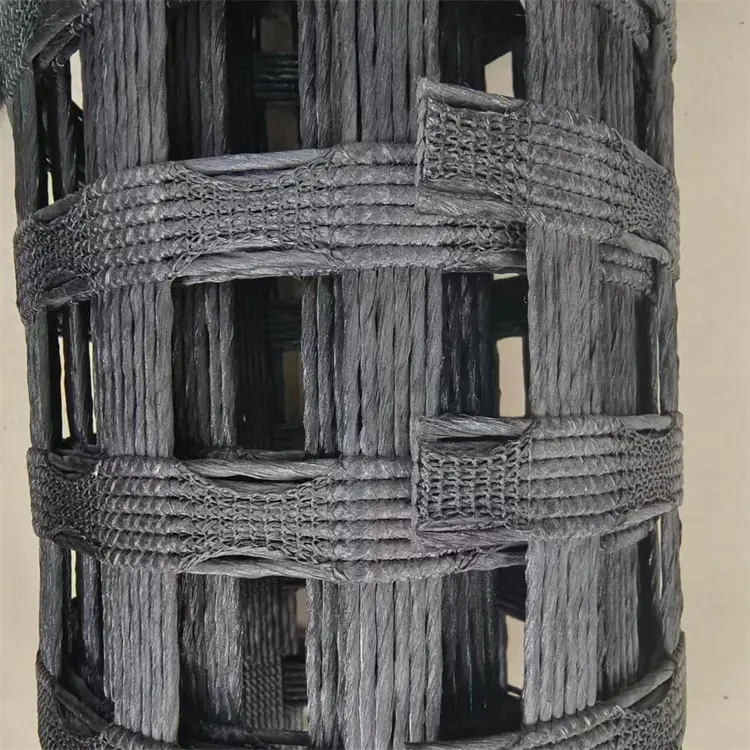
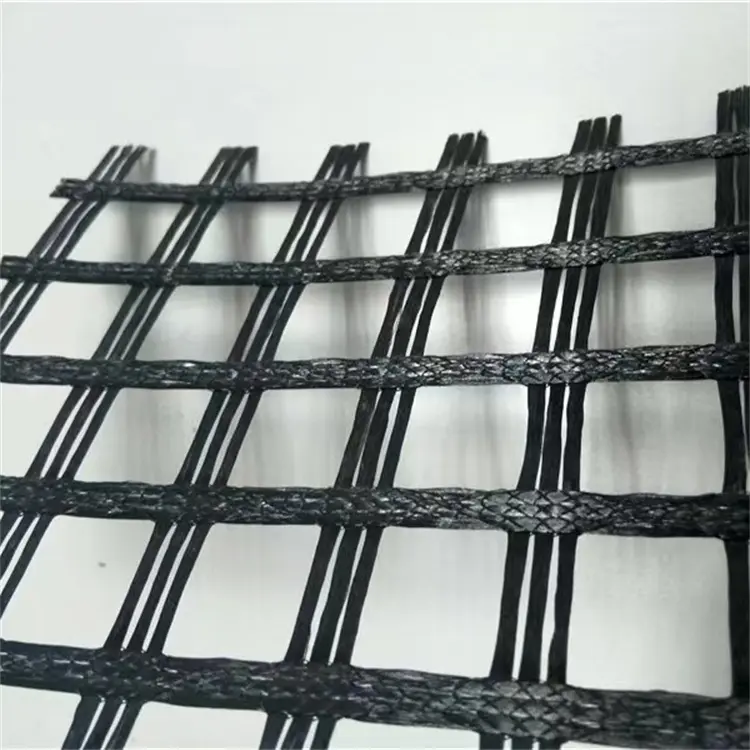
Product Overview: High-Tech Fibers to Pure Science A Polyester Geogrid is not a cheap plastic tangle but rather a composite entity comprising high-modulus load-bearing yarns knit or woven together and then coated with protective agents To yield a reinforcement component that can be relied on for its predictable mechanical performance and fabrica ion integrity, no Polyester Geogrid is just an off-the-shelf plastic net. It is precision-engineered from scratch with high-modulus yarns, carefully woven or knitted and Endowed with anti-aging substances (preservative treatment), making it in fact a reinforcement element that the performance may mechanical properties of anyone in full appreciation.
Core Material Science: Why Polyester (PET)? Its molecular structure and engineering properties have led us to select polyester as the load-carrying component:
– High Tensile Strength A: PET fibers are extremely strong on a weight-for-strength basis and that is important because they must pull their load in soil masses.
· Low Elongation (High Modulus): Under load, it retains only a little elongation and may stretch only 10-13% at break; This guarantees that any reinforcement is realized at a very limited strain level, which is vitally important for controlling deformations in structures.
· Superior Creep Resistance: This is the most prominent feature of. PET is different from polyolefins (PP, HDPE) in that it retains its strength over dwell times lasting even decades under constant loading, making it an excellent material for permanent soil reinforcement applications.
· Excellent Chemical Stability: High-quality PET geogrid is formulated to be stable in the harsh soil environments, withstanding pH ranges from 2.0 to 12.0 and remaining unaffected by soil microorganisms.
· Fatigue Resistance: It holds up under dynamic and cyclic loading situations such as heavy traffic or seismic events.
Technical Characteristics & Performance Advantages
The engineered design of Polyester Geogrid delivers a series of real-world benefits in actual application cases.
Exceptional Long-Term Strength (Creep Resistance)
The low-creep properties of polyester ensure that the geogrid’s design tensile strength, i.e. the maximum load it can carry while still retaining its shape for a prolonged period of use, remains high. This phenomenon stands up to rigorous testing (e.g., GRI GG4) and is fundamental for ensuring stability in permanent constructions Safe from Soil Micro-organisms
PET geogrid is biologically unaffected by soil micro-organisms, and so remains in service for decades.
High Junction Strength and Load Transfer Efficiency
In quality products, the protective coating fuses thread intersections-record in-camera as a strong junction of its own. This ensures that tensile loads are carried efficiently from longitudinal ribs to transverse members and into surrounding soil (mobilizing the entire reinforcing capacity of your product).
Key technical data/DS series polyester geogrids are produced using high-quality Chinese polyester turn and weft yarn. Durable and chemically stable, these geogrids will remain intact under construction conditions as well as in aggressive soil environments. The PET fiber core plus the protectivechaing immediately-capable in protections are together resistant to alkali, acid, ultraviolet deterioration
The polymeric fibers are dimensionally stable and high liquid absorption rates are a problem It can be a problem influential to the behavior of a polyester geogrid. An increase in downside ecological stresses would therefore lead directly towards an inability of pure clay-type soils but not siltstone or hardened siltstones as found elsewhere in the world.
Manuafacturing Process: From Yarn to Integrated Grid
The production of high-performance polyester geogrids involves a number of critical stages that require accurate control :
Raw Material Preparation:PET filament is sourced and prepared. These fibers are the geogrid’s main load-bearing component.
Yarn Formation (Twisting/Warping): The individual filaments are combined and twisted into strong yarns, which are then wound onto bobbins for the next stage.
Knitting or Weaving (Grid Formation): New Warps are formed. A common method is warp-knitting, where longitudinal and transversal yarns are precisely interlooped to form a dimensionally stable network with integral junctions which are readily recognizable as being characteristic features of the product. This is the process which gives the grid the characteristic aperture for soil interlock.
Protective Coating Application: The knitted grid is coated. Normally this is done with PVC (Polyvinyl Chloride), bitumen or acrylic materials. The purpose of this step is two-fold :
· Protects the PET core from mechanical abrasion during installation.
· Improves its resistance to chemicals and UV light so that it will last under particularly difficult conditions over the long term.
Manufacturing Throughput and Quality Control: The coated geogrid is allowed to cool, then thoroughly checked over for defects of any kind before being hacked into separate rolls that are cut-to-spec. A product life can be extended by quality control inspection methods such as these.
Rigorous testing for tensile strength (e.g., ASTM D6637), junction strength, and dimensional accuracy is undertaken.

Key Product Specifications
· Tensile Strength Range: Available from 30 kN/m to over 300 kN/m in the primary direction, with biaxial variants offering balanced strength in both.
· Aperture Sizes: May be from 12.7×12.7mm to 25.4×25.4mm or more in size. This range is optimized for interlock with granular soils and cohesive fills.
· Roll Dimensions: Customizable widths (usually 1–6 meters) and lengths to suit project logistics.
· Coating Options: PVC, bitumen or acrylic, selected based on environmental conditions and use.
The inherent high tensile strength of DS series geogrids means that thin section foundation fills can often be used. This allows substantial earthwork savings to be realized by reducing bothoverfill quantities as well as the space required for executing sensitive work like foundation placer consolidation offine grain fill materials.
There are many appropriate fields for the use of Polyester Geogrid but it is perhaps not appropriate in all such locations where ground stabilisation has been indicated
MSE Reinforced Earth Retaining Walls
This is a flagship application. Multiple layers of high-strength polyester geogrid are incorporated within the compacted backfill behind modular block or precast concrete panel facings. The geogrid creates a cohesive gravity-resisting mass, allowing construction of tall, safe and aesthetically versatile walls. Here, the requirement for creep resistance is decisive, as the wall has to maintain its shape for many years
Reinforced Steep and Inclined Slopes
The use of polyester geogrid in the construction of slope is one of its most striking applications. For highway and rail cuttings, bridge abutment ear, and even landfill expansion opportunities Polyester Geogrid has allowed use more than ever before steeper than the natural angle repose for earthwork is necessary to accommodate land take minimized volumes offills and a stable softening off, living face. It is also usedto restore failed slopes by stripping, reusing and rebuilding the failed soil over again withg eogrid layersCertification and reputation
In the words of a senior engineer from a major design institute; **quotes that come from engineers and designers certifying each particular type of geotechnical fabric after every unique test! “\I am aware there is a lot for us to learn in comparing our polyester geogrid’s overall performance between different manufacturers,” he adds solemnly while remarking on DS series\’s worthDeadline and Subgrade upgrade
On soft soils, one or more layers of polyester geogrid can be placed beneath fill embankments or structural fills. With its relatively small mesh size and inherent high tensile strength, this geogrid is particularly effective in curbing horizontal and vertical deformation of foundation soils due to settlement over the long term.
· Enable uniform load and reduce differential sediment.
· Raise bearing capacity and form smooth standby planes.
· Branch lines and Preventing Sub-ballast Excavation
Bridge Abutments and Load-bearing Structures
The high modulus and high strength of PET geogrid make it suitable for reinforcing the fills underneath bridge abutments and approach slabs so that Structural settlement after completion of the work is kept to a minimum–and in particular, the bridge is not supported on a fragile “roll”.
Landfill and Containment Systems
Utilized in base liners and covering systems to reinforce slopes, support gas and liquid collection pipes, and offer permanent stability for waste-containment engineering.

Installation Overview:
Foundation Preparation: A level, compacted surface is prepared.
Geogrid Placement: Rolls are unfurled with the main strength direction perpendicular to the wall face or slope crest. Adjacent panels are overlapped as specified (usually 150-300 mm).
Anchoring and Tensioning: The geogrid is anchored against the wall face or crest, tightened to remove any slack.
Backfilling and Compaction: Fill material is deposited, spread and compacted in thin layers directly over the geogrid, working from the anchored end outwards.
FAQ for International Buyers and Specifiers
Q1: What is key difference between Polyester (PET) Geogrid and Polypropylene (PP) Geogrid?
A: The main difference lies in long-term creep behavior and material stiffness. Polyester geogrid has a much higher resistance to creep (deformation under constant load) and a higher modulus (more rigid), so it is the material of choice for permanent, critical works like increasing retaining walls and bridge abutments up hill where long-term deformation must be kept at a minimum. PP geogrid is great for applications like start-up and temporary works where some long-term strain is acceptable, and also has advantages over polyester in cost and chemical resistance in certain environments. The choice therefore depends on fatigue life, force requirements, and soil regimen.
The coating goes into the performance it also protects the load-bearing PET yarns from mechanical abrasion during installation and from chemical/UV attack over the structure’s life. In addition, it locks yarn intersections to create high-strength, integral junctions that are vital for efficient load transfer. A high-quality, well-bonded coating (such as PVC saturation) not only guarantees the long-term durability of your geogrid but also ensures its consistent mechanical behaviour.
Q2: Can Polyester Geogrid be used in high-pH (alkaline) environments, such as behind concrete retaining walls or in lime-stabilized soils?
A: Standard polyester may suffer from hydrolysis (chemical damage) in high-pH soil (e.g. some types of lime-stabilised soils) where the level of moisture is continuously maintained. However, high-grade PET geogrids are specifically formulated using special protective coatings and resin systems to resist hydrolysis in alkaline (high-pH) environments. In these applications, it is important to specify a grade specially designed for such high pH conditions and to furnish the manufacturer with your data on soil chemistry so that they can verify the suitability of their product for use there.
Q3: What certificates and test data shall I request from the supplier of Geogrid manufactured by Polyester?
A: For critical infrastructure projects, you should insist on full documentation (usually):
· Third-Party Test Reports: Tensile strength (ASTM D6637), cellular restraint and hydrostatic pressure resistance (GRI GG4).
· Material Certifications: Our production facilities are certified to ISO 9001 standards with mill certificates for all raw materials.
· Installation Damage Trials: Retained strength after installation damage is simulated through testing and testing again.
· Certificate of Conformance (COC): This is given to ensure that the finished products pass all of the specified requirements by meeting them exactly on paper or in reality.
Related News